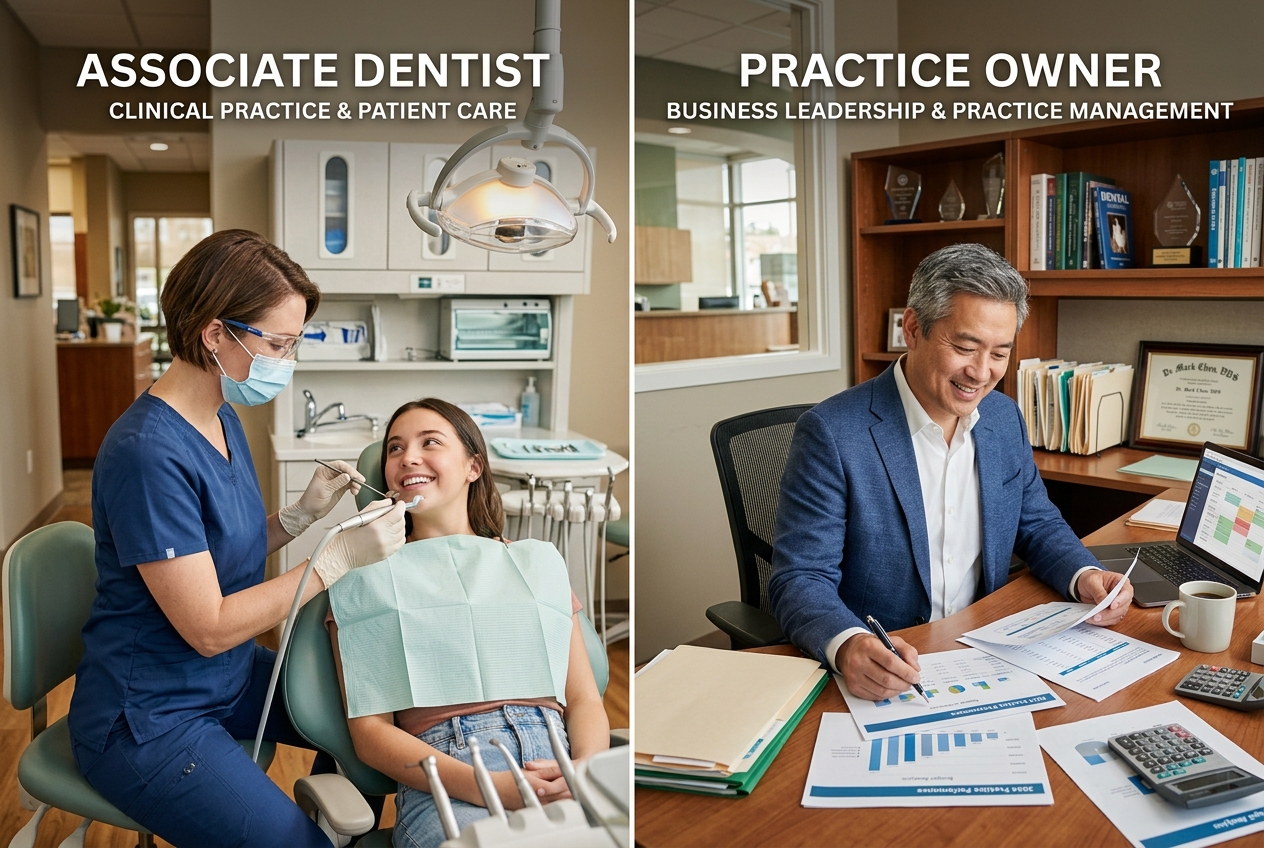
At some point in your dental career, you will face this question: should I buy a practice or stay as an associate? There is no universally right answer. It depends on your personality, financial situation, risk tolerance, and what you want from your career.
Let me give you an honest breakdown of both paths, including the numbers people usually do not talk about.
The money question
Let us start with what everyone wants to know: who earns more?
| Career Stage | Associate | Owner |
|---|---|---|
| Early career (0-3 years) | $100K – $150K | Rarely applicable |
| Mid-career (4-10 years) | $150K – $220K | $200K – $350K |
| Senior / Established | $200K – $300K | $300K – $500K+ |
Based on industry surveys and recruitment data. Individual results vary significantly.
On paper, owners earn more. But there is a catch: the variance is huge. Some practice owners earn less than their associates after accounting for loan repayments, stress, and the hours they put in. Others build multi-location empires worth millions. The average hides a lot of individual stories.
Associates typically earn 40-45% of their billings. A good producer billing $500K takes home around $200K-$225K. The ceiling exists, but it is higher than many people assume—particularly if you work across multiple practices or develop a strong referral base.
The case for staying an associate
There are legitimate reasons why many experienced dentists choose to remain associates for their entire career. It is not a failure to avoid ownership.
You walk away at 5pm. When your last patient leaves, your work is done. No lying awake thinking about cash flow, staff problems, or equipment repairs. No weekend admin. The mental load difference is significant.
Zero financial risk. You do not have hundreds of thousands in debt. If the practice struggles, that is the owner's problem. If you want to take a year off to travel, you can.
Pure clinical focus. You can dedicate all your professional energy to getting better at dentistry rather than learning about HR, marketing, accounting, and facilities management.
Flexibility. Changing jobs is straightforward. Moving cities is possible. Working part-time is easier to negotiate.
The case for ownership
Ownership is not for everyone, but for the right person, it offers rewards that associateship cannot match.
No income ceiling. Your earnings are limited only by how well you can build and run the business. Bring in associates, expand to multiple locations, or develop premium service lines—the possibilities compound.
Building an asset. Every dollar of profit you reinvest grows your practice's value. When you sell, you capture that value. Associates trade time for money; owners can eventually trade the business itself for a significant payout.
Control. You decide the equipment, the team, the culture, the patient experience. No more frustration with how someone else runs things.
Tax advantages. Business structures offer legitimate ways to manage your tax position that are not available to employees.
The honest downsides of ownership
The people selling practice sales rarely mention these, but you should know:
Staff management is hard. Hiring, training, dealing with conflicts, managing underperformers—this takes a toll. Most dentists receive zero management training and learn through painful trial and error.
The financial stress is real. Even successful practices have slow months. You will lie awake some nights wondering how to make payroll or pay for that unexpected equipment failure.
Taking leave becomes complicated. The practice does not generate income when you are away, but the rent and wages keep flowing.
You are ultimately responsible for everything. When things go wrong—and they will—it all lands on you.
Which personality suits each path?
Beyond the finances, your temperament matters more than most people acknowledge.
Stay an associate if you value predictability and work-life separation, dislike managing people, prefer to focus purely on clinical excellence, or want maximum flexibility in your career.
Consider ownership if you are entrepreneurial and enjoy building things, can handle financial uncertainty and delayed gratification, see dentistry as a business not just a job, or are frustrated working within someone else's systems.
The middle ground
It is not strictly binary. Many dentists find hybrid arrangements: partnerships where you share risk and reward, equity associate positions where you buy in gradually, working as an associate while owning a practice elsewhere, or part-ownership arrangements.
If you are considering ownership, the best preparation is working as an associate first. Pay attention to what makes good practices work. Learn from other people's systems—and mistakes—before putting your own money on the line.
Common questions
How much does it cost to buy a dental practice?
Australian practices typically sell for 60-100% of annual revenue. A practice billing $1M might cost $600K-$1M. See our guide on buying a dental practice.
What percentage do associates typically earn?
Most associate dentists earn 40-45% of their billings. Top performers at high-volume practices can sometimes negotiate up to 50%.
When is the right time to buy a practice?
Most dentists wait 3-7 years after graduation. You need clinical confidence, savings for the deposit, and ideally experience at multiple practices to understand what works.
Develop your business skills
Practice management CPD helps you understand the business side—whether you own or not.