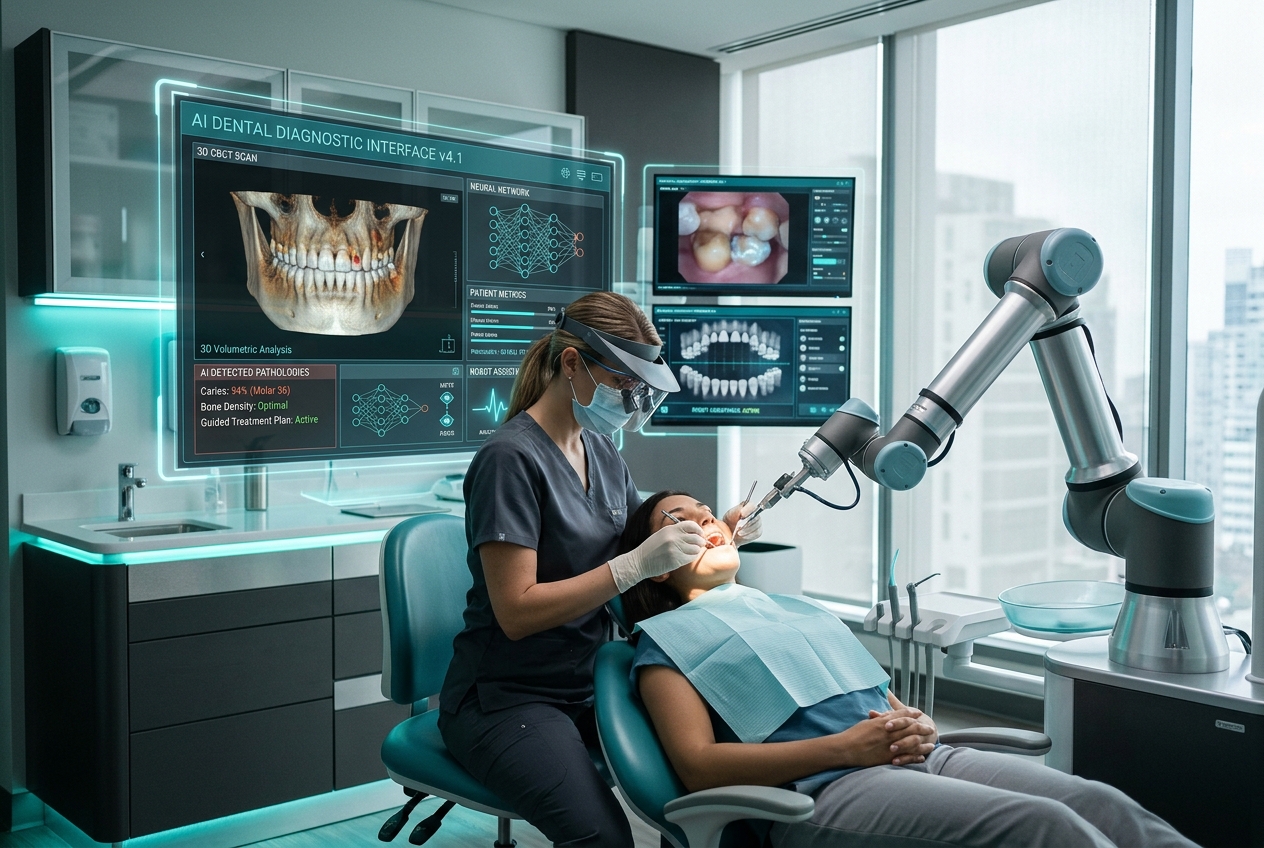
Every dental trade show now features AI prominently. Every practice management company claims to have it. But strip away the marketing, and you find that most products labelled "AI" are either genuinely useful, promising but early, or just basic automation with a trendy name.
This guide cuts through the hype. What AI tools are actually worth your money and attention in 2024? What should you watch but not buy yet? And what is pure marketing?
What actually works today
AI-assisted caries detection on radiographs is the most mature application. Companies like Pearl, Overjet, and VideaHealth have FDA-cleared systems that analyse bitewings and panoramics, highlighting areas of potential decay. Multiple studies show these systems catch caries that clinicians miss, particularly interproximal lesions.
The key is using AI as a second opinion, not a replacement for your clinical judgment. You still review every image. The AI just flags areas worth a closer look. For practices that process high volumes of radiographs, the time savings and diagnostic support justify the $300-800 monthly subscription.
Intraoral photo analysis is another mature application. Software can now automatically chart existing restorations, identify wear patterns, and document conditions from intraoral photos. This saves significant documentation time and creates better patient records.
Patient communication tools using AI can generate plain-language explanations of treatment plans or create annotated images showing patients what you are seeing. These improve case acceptance by making clinical findings more accessible to patients.
Promising but wait
Several AI applications show real promise but are not quite ready for mainstream adoption.
AI treatment planning systems are emerging that suggest optimal treatment sequences based on case data. The technology is improving rapidly, but most systems still require significant human oversight and do not integrate well with existing practice management software.
Voice-activated clinical notes let you dictate findings that AI structures into proper formats. Accuracy is improving but still inconsistent with dental terminology. Worth watching, not worth committing to yet.
Periodontal risk prediction using radiographs and probing data shows promise in research settings. The idea is predicting which patients will progress to more severe disease. Clinical validation is ongoing.
What is mostly hype
"AI" practice management features are often just automated reminders or basic reporting relabelled. If it was possible with software from 2015, it is not really AI. True AI in scheduling and operations optimisation exists but is rare.
Generic chatbots for dental websites usually frustrate patients more than help. If the chatbot cannot actually book appointments, answer complex insurance questions, or handle unusual requests, it just becomes a barrier between patients and your team.
Autonomous diagnosis claims should be viewed with extreme scepticism. No AI should diagnose conditions without clinician review. Products claiming to independently diagnose are either overstating capabilities or operating in an ethically questionable space.
How to evaluate AI products
Before investing in any AI product for your practice, ask three questions.
First, what evidence exists? Are there peer-reviewed studies, or just marketing claims? Has it received FDA or TGA clearance for its claimed purpose? Can you see real-world results from practices using it?
Second, what problem does it actually solve? Will it save meaningful time or improve outcomes? Is this a problem you actually have, or a solution looking for a problem? What is the real workflow impact?
Third, what are the limitations? What does it not do well? What training is required? How does it integrate with your existing systems?
If a company cannot clearly explain how their AI works or provide evidence of its effectiveness, be cautious. "AI" is often used as a marketing buzzword for basic software features.
The human element
AI will not replace dentists. The evidence is clear: AI works best as a diagnostic assistant, not a replacement. It can help you catch things you might miss, document more efficiently, communicate better with patients, and standardise quality across your practice.
But clinical judgment, patient relationships, manual skills, and ethical decision-making remain firmly human domains. The practices that will benefit most from AI are those that view it as a tool to enhance human capability, not replace it.
| Application | Readiness | Typical Cost |
|---|---|---|
| Caries detection (radiographs) | Ready | $300-800/month |
| Intraoral photo analysis | Ready | $200-500/month |
| Patient communication | Ready | Varies widely |
| Treatment planning | Early | $500-1000/month |
| Voice-activated notes | Early | $100-300/month |
Costs are approximate and vary by vendor and practice size. Always request trials before committing.
Getting started
If you decide to adopt AI tools, start small. Trial one tool thoroughly before adding more. Train your team properly—AI tools are only as good as the humans using them. Maintain oversight and never fully automate clinical decisions. Track your actual ROI by measuring time saved or outcomes improved.
AI in dentistry is evolving rapidly. What is experimental today may be standard practice in two years. Stay informed, but do not feel pressured to adopt everything immediately. The goal is better patient care and more efficient practice—not technology for its own sake.
Common questions
Is AI caries detection accurate enough to use?
The FDA-cleared systems have shown comparable or better sensitivity to radiologists in studies. Use them as a second set of eyes, not a replacement for your judgment.
Will AI replace dental jobs?
Not clinical roles. AI may automate some administrative tasks and assist with diagnosis, but the hands-on, relationship-based nature of dentistry limits automation.
Are there CPD courses on AI in dentistry?
Yes, and they are becoming more common. Look for courses that focus on practical application rather than just the technology itself.
Stay current with technology
Browse courses on digital dentistry, new technologies, and practice innovation.